Why the World’s Next Data Center Capital Is Betting on People, Not Just Power
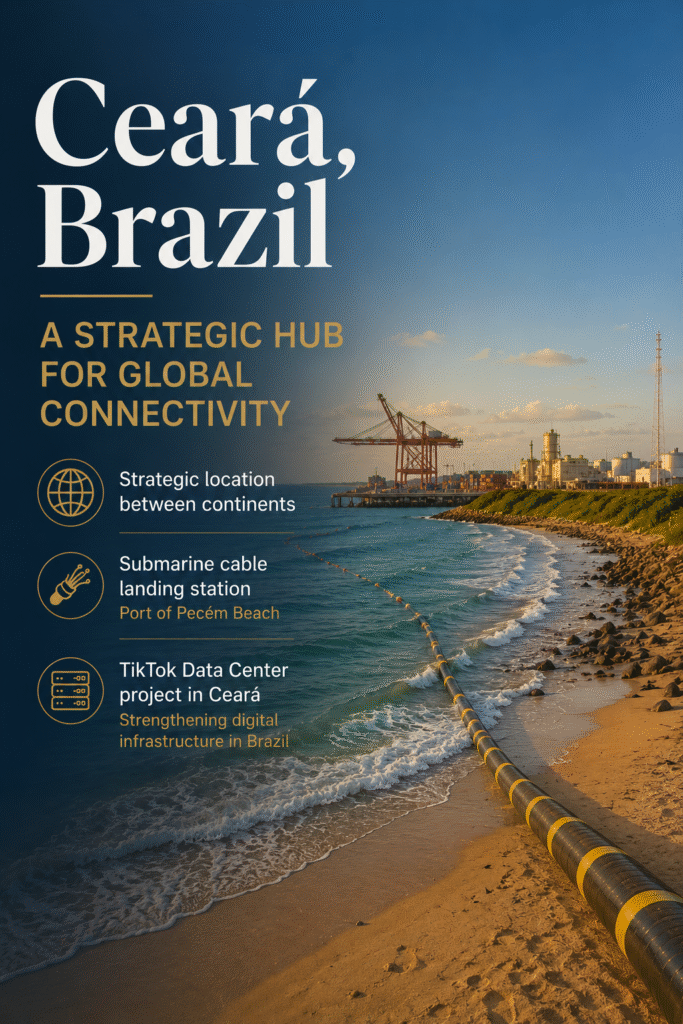
Every infrastructure map of Brazil’s tech future now points to the same coastline. Fortaleza, capital of the state of Ceará, has quietly become the country’s most strategic address for high-performance computing, a city where equatorial sun meets some of the densest submarine cable landings in the Americas, and where a deep-water port built for global logistics sits an hour from downtown. For any company evaluating where to place its next data center, Ceará is no longer a curiosity. It is a shortlist item.
But there is a detail that rarely makes it into the site-selection deck: a data center does not build, commission, or run itself. It takes engineers, network architects, project managers, and specialized technicians, often flown in from the company’s home base for months at a time, to get a facility from groundbreaking to full operation. And that is where expansion strategies quietly stall. Companies that meticulously model power costs and latency budgets can still lose weeks, or a launch window, to a visa application filed the wrong way.
The companies that move fastest into Brazil are not necessarily the ones with the biggest capital commitment. They are the ones that treated immigration planning as part of the engineering plan from day one.
The Infrastructure Case for Ceará
The numbers behind Ceará’s rise are not marketing, they are physical. The state sits at one of the shortest oceanic distances between South America, North America, and Europe, which is precisely why a growing number of international subsea cable systems now make landfall in Fortaleza. For a data center, proximity to cable landing stations translates directly into lower latency and fewer single points of failure.
Layer onto that Ceará’s solar irradiation, among the highest in Brazil, and a fast-scaling renewable energy grid, and the state offers something few emerging markets can: the physical inputs a data center actually needs: power, connectivity, and logistics, concentrated in one place. The Port of Pecém adds a fourth advantage that is easy to underweight: the ability to import specialized equipment at industrial scale, close to the build site itself.
This is why global technology companies are no longer treating Ceará as a regional curiosity. It is becoming a reference point in the same conversation as other emerging digital infrastructure hubs, with the added advantage of being anchored in Brazil’s legal and economic stability.
The Part the Site-Selection Deck Leaves Out
Here is where strategy and execution diverge. Bringing the infrastructure online is a construction and procurement problem. Bringing the team online, the people who commission the servers, calibrate the cooling systems, and train the local workforce that will run the facility long-term, is an immigration problem. And immigration, unlike procurement, does not respond well to being handled at the last minute.
A technical expansion into Brazil typically requires more than one type of visa, deployed in sequence and matched precisely to each professional’s role:
- Work visas, for engineers and technicians assigned directly to the project on a fixed-term or ongoing basis.
- Manager and executive visas, for the leadership responsible for setting up and overseeing the Brazilian operation, often tied to establishing or representing the local entity.
- Investor visas, for the capital and ownership structure behind the expansion itself, relevant whenever the move involves forming or investing in a Brazilian company.
- Technical assistance visas, for short-term specialists brought in for commissioning, training, or troubleshooting phases that do not require a long-term relocation.
Choosing the wrong category, or applying for the right one without the right documentation, is the single most common reason technical rollouts in Brazil lose momentum. A data center commissioning schedule built around a specialist’s arrival date does not have room for a resubmitted application.
Compliance Is Not Optional: It Is the Foundation
None of these pathways exist in isolation from Brazilian tax and labor law. Every visa category carries obligations that follow the professional and the company well past the arrival date: payroll structuring, social security contributions, the correct classification of employment versus service-provision relationships, and reporting requirements that differ depending on whether the individual is on assignment, locally employed, or acting as an investor-executive.
Getting this wrong does not just create legal exposure. It creates friction at exactly the moment a company can least afford it, mid-construction, mid-commissioning, mid-launch. A visa strategy that is not built in coordination with tax and labor compliance is not really a strategy. It is a liability with a delayed invoice.
Immigration Planning as a Strategic Asset
The companies expanding into Brazil most successfully share a pattern: they treat immigration planning the same way they treat their power purchase agreements or their equipment procurement timeline, as infrastructure that has to be in place before the project needs it, not after.
Done right, an immigration strategy does more than keep a company compliant. It becomes a competitive advantage. It means the right engineer is on-site the week the servers arrive, not the month after. It means an executive can represent the company locally from the outset instead of operating from abroad. It means the entire technical rollout moves at the pace the business actually needs, not the pace of a bureaucratic backlog.
This is the case for building immigration planning into the expansion roadmap from the earliest conversations, alongside the site-selection and financial modeling that already happen at that stage. The right visa strategy, aligned with tax and labor compliance, is not a cost center. It is what allows every other investment in the expansion to actually pay off on schedule.
Ceará has the sun, the cables, and the port. What determines how quickly a company can put that infrastructure to work is whether its people can get there, legally, efficiently, and without surprises.
Migravisa specializes in structuring immigration strategies for companies expanding technical operations into Brazil, aligning visa pathways with tax and labor compliance from the earliest stage of planning. Talk to our team to map the right strategy for your expansion.
Our team is committed to staying up-to-date with the latest developments in the legal field and offers a range of specialized services to help your move to Brazil .
We have over 25 years of experience providing high-quality immigration services to our International clients.
We use state-of-the-art technology to provide efficient and effective immigration solutions.
We are confident that with our guidance and support, you will be able to successfully establish and grow your business in this dynamic country.
Do not hesitate to reach out to us if you have any questions or concerns along the way, book your appointment today.